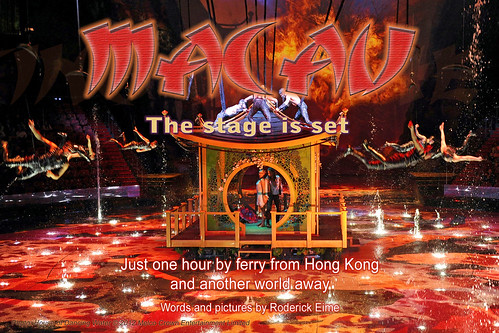
In July I returned to Macau to see for myself the development that has occurred since my previous visit in May 2006. Macau is developing at a staggering pace, to say the least.
Macau in a Hurry: 12 Hours in Macau
After almost 400 years of blissful colonial slumber, the new Special Administrative Region of Macau is already rivalling the world’s major leisure capitals. Roderick Eime ponders the possibilities for a whirlwind tour.
Half a day in Macau is like twenty dollars in a toy shop - so much to choose from, but some hard choices await.
Historic Snapshot:
Even though Macau is best known for its rich Portuguese heritage and eclectic mix of European and Asian cultures, the town’s maritime and trading history dates back to the 5th century and earlier when coastal traders and fishermen used Hoi Keang for resupply. Many historians also believe the port was used by the enormous fleets of the Ming dynasty during 1421-23 as part of their theorised discovery of the world.
In 1513, the Portuguese merchant and explorer, Jorge Alvares, landed and almost immediately began a trading relationship with the local Cantonese (Guangzhou). The Europeans established various temporary outposts before reaching an arrangement with the mandarins in 1557 to settle the tiny peninsula at the mouth of the Pearl River estuary, now modern Macau.
Through intermittent chapters of stagnation and turmoil, most significantly Macau has returned to Chinese rule as a Special Administrative Region (SAR) of the People's Republic in 1999, ending 329 years of colonial Portuguese stewardship.
The Hard Choices:
Before you arrive, grab your copy of Lonely Planet and do some homework. You’ll quickly discover there are several paths available to you. For example;
Chinese culture and cuisine.
Portuguese architecture and history.
Modern diversions: gaming, adrenalin and nightclubbing
Peruse the list below and begin your shopping list of activities
Macau Tower
Designed principally by Gordon Moller of CCMBECA, New Zealand, Macau Tower is one of the world’s greatest city towers. At 338m, it is the 10th tallest in the world. Visitors can enjoy a scenic meal at the 360o Café and those with a yen for thrills can take the ultimate plunge with a 233m drop on the AJ Hackett Skyjump; one can climb the mast or walk the elevated platform. Not for the faint-hearted.
Guia Fortress Lighthouse and Chapel
One of several fortresses and barracks throughout Macau, the Guia was built between 1637-38, and occupies the top of Guia Hill, the highest point in Macau. Originally designed to defend the city from sea attacks, its position overlooking the entire city makes it one of the best observation posts.
Fisherman’s Wharf
Located at Macau’s Outer Harbour, this themed tourist district contains a dense assortment of restaurants, bars, nightclubs and retail establishments built to reflect Macau’s original colonial style as well as drawing on other maritime cultures and locations like Cape Town, Amsterdam and New Orleans.
Museums
Macau is a museum-goer's delight. The city has numerous world-class museums dedicated to the its rich natural and cultural history.Tip: For MOP$25 for adults and MOP$12 for children and seniors, visitors can buy a museum pass that grants entry to the Grand Prix Museum, Wine Museum, Maritime Museum, Lin Zexu Museum, Museum of Art and Museum of Macau.
St Paul’s Crypt and Museum of Sacred Art
Built at the bottom end of the inner area of the St. Paul's ruins is this superb museum with a rich display of religious art and artefacts. It was built in the location of the chancellery of the ancient church which was destroyed by fire in 1835.
Maritime Museum
Adjacent to the A-Ma Shrine, this compact, but beautifully detailed museum celebrates Macau’s complex maritime history. The three floors are arranged like decks and include excellent displays of ancient explorers like Vasco da Gama and the great Ming Dynasty Admiral Cheng Ho, plus fascinating models and dioramas.
Grand Prix Museum
Assuage your motor racing urge with a visit to this museum which includes actual race cars, bikes and replicas along with memorabilia and souvenirs. Jump into the simulator for a race around the famous circuit.
The Museum of Macau
Located at the Monte Fort and facing St.Paul's ruins, the museum also occupies the ancient fortress built by the Jesuits at the beginning of the 17th Century. This museum is a wonderful introduction to the development of life and civilisation in and around Macau over the centuries.
Macau Grand Prix: Asia’s Most Significant Motor Sport Event
First held in 1955, soon after the restoration of Formula One in Europe after its wartime hiatus, the Macau Grand Prix has evolved as arguably the most historic and significant Asian motor sport event.
If you arrive in Macau during Grand Prix, there will be little else going on as the entire city is consumed with this high octane carnival.
The 54th Macau Grand Prix will be held from November 15th to 18th 2007.
Macau’s unique European cultural fusion has spawned a range of colourful cultural events including arts, music and fireworks festivals, a dragon boat regatta, golf tournament and a marathon foot race. Depending on your arrival date, you could find yourself consumed with any of these events.
UNESCO World Heritage Self-Guided Tour
The United Nations recognised the very special significance of the architectural heritage of Macau by listing the centre of the old city as a World Heritage site of cultural significance.
The historic and cultural “branding” of old colonial Macau is perhaps best portrayed by the preserved façade of the Cathedral of Saint Paul. Built during the last decade of the 16th Century by the Jesuits, the building was destroyed by fire in 1835 during a typhoon.
The proximity of the landmarks makes this expansive World Heritage site an engaging and vigorous self-guided walking tour that could easily occupy several days.
Culture and History Getting You Down? – Roll the Dice!
Apart from the cultural and historic significance of the port city, Macau is known worldwide for its gambling history which began with the Chinese workers and merchants who populated the growing city soon after the arrival of the Portuguese. Macau is now the highest-volume gambling centre in the world
Since 2002, the gaming scene has been deregulated and new players are coming to town including the Sands Macau, the largest casino in the world as measured by the number of gaming tables, in 2004 and Wynn Macau in 2006. Other casinos and hotels opening before 2010 include: The Venetian Macao, Four Seasons, MGM Grand Macau, Ponte 16, Far East Consortium Complex, Grand Hyatt, Galaxy Cotai Megaresort, City of Dreams, Oceanus and Mandarin Oriental.
Dining
As with any Asian society, food plays a major role in Macau, but its cuisine is flavoured by hundreds of years of multicultural influences Among the more popular Macanese dishes are African chicken grilled in peppers, Tacho (a robust stew of Chinese vegetables and different meats), Galinha Portuguesa (chicken cooked in an oven with potatoes, onions, egg and saffron), Linguado Macau (Macau sole fried and served with green salad) and Porco Balichao (Balichao pork). A popular dessert is the Jagra de ovos (sweet egg tart). The best sampling of these local specialties can be found at the unique Macanese style eateries dotting the island. Operated by Portuguese-speaking European descendants, these quaint little cafes and restaurants capture the essence of Macau perfectly – check them out along Rue Almirante Sergio and along the Praia Grande. Other cuisines can also be enjoyed widely in Macau, include excellent Cantonese fare, a variety of Western food, Japanese cuisine and ethnic Portuguese dishes.