Tarkine Wilderness Adventure - At home in the wilderness

from 28 October 2013, Rod will disappear into the Tasmanian wilderness on a trip to the acclaimed Corinna Wilderness Experience
"an escape from mass tourism, to one of the most remote and beautiful parts of the world."
Editorial and pictorial will be available from first week November 2013
these images from the website

Bangkok by Design: The Thai capital's fun and funky new hotels (updated)

Main image: Pullman Bangkok Hotel G foyer. Top: Scarlett
Following an on-going theme, Rod strives to investigate this new wave of 'designer' hotels sweeping the crazy capital of Thailand. Currently that roster reads:
  • Pullman Bangkok Hotel G (Accor)
  • Sofitel So Bangkok
  • VIE Hotel (Accor M Gallery)
  • Hansar
  • Mode Sathorn Hotel (by Siam@Siam)
  • Muse Hotel (Accor M Gallery)
  • The Siam
Plus Rod regularly samples the staple offerings from the best known chains.
For a complete list, please email.

Burmese Days - The Road to Mandalay - A tradition revived


Years in the making, Rod gets aboard the smaller boutique RV Katha Pandaw at Mandalay for an exploration of the upper Irrawaddy River and the historic colonial-era port of Katha, the spiritual home of the once great Irrawaddy Flotilla Company.
Editorial and pictorial will be available from mid-October 2013

Images on Flickr

Freelancer or Freeloader: the quest for the 'free lunch'.

"The Travel Writer" (stolen from the Internet, source unknown)
It’s one of those things all professional travel writers have to endure.

“You’re always going on free trips!”

“So, who’s paying for this?”

Continually being interrogated by fellow travellers, family members and other office-bound journalists is something I always dread. While there is always varying financial participation by all parties in any given familiarisation trip, there is an old truism that always holds.

“There’s no such thing as a free lunch.”

Now legend has it, that once upon a time all a journalist had to do was call their mate at the airline and a First Class ticket came by courier with a bottle of French Champagne. Now, there might be one or two esteemed scribes still alive who can command that kind of worship, but let me assure you, my dear reader, those days are OVER.

Even getting an upgrade on a fully paid ticket is a chore. Lounge admission, check-in queue jumping or an amenity pack is the best we can often hope for. While some airlines may be marginally more generous than others, every carrier is now constrained by this new austerity.

Hotels, depending on seasonal demand or other commercial imperatives, vary in their largesse, but even these pleasure palaces are now tightening their belts and scrutinising media guests more closely, both pre- and post-stay. Included breakfast is often a bonus and dinner, well, you must know someone!

But the moral of this story is a three-letter-word: ROI (Return On Investment). Put simply, it is the dividend obtained by any party after making a capital (or other) investment in a project.

And it’s not just an airline, hotel, cruise line or destination that makes such a calculation. A professional writer must also determine whether it is worth their while to accept any particular offer. My measurement criteria are similar, I’m confident, to my colleagues in this respect.
  • Exclusivity. How often has this product been featured? Will I be travelling with similar hungry freelancers all pummeling the same outlets? This directly relates to ...
  • Saleability. How many stories can I reasonably expect to sell from this single exercise? This often depends on stuff you won’t discover until you’re in the middle of the trip eg how rigid is the itinerary, how much free time to explore your own story leads, how fertile is the trip with regards to multiple story angles?
  • How much is it going to cost me? There’s no point forking out $3000 on airfares if you’re only going to sell two stories at a few hundred bucks each. Some hosts think they’re offering you this irresistible opportunity to travel to the other side of the country or overseas to stay at their to-die-for villa. No, sorry, that’s not such a good deal.
Public relations reps, CVB managers, and hotel GMs will measure the resultant publicity using a formula that multiplies the cost of taking an ad in the media by a factor that can vary from three to eight times. So, for example, if you stay in a 5-star hotel with dinner and niceties at a rack rate of $500 and the story runs over one page in a magazine that charges $5000 for a full page, that is conservatively $15,000 in equivalent value. An ROI any host should be delighted with.

In recent times, this whole scenario has been shaken up with the arrival of online media and the ‘blogger’. Measuring penetration in this new media has left many PR and media folks groping for traction on this slippery, muddy playing field. Bloggers can come from any part of the media sphere. Some are seasoned journalists and talented writers exploring or creating new outlets, while others are idle opportunists looking for that ‘free lunch’ with no concept of ROI, conflict-of-interest or even basic journalistic ethics.

There are lots of tricks used by bloggers, tweeters and Instagrammers to inflate their penetration and ‘engagement’ ranging from buying bulk ‘likes’ and followers to automatic click-bots. But that expose is for a whole different discussion.

But whether blogging or not, freelance journalists can suffer varying degrees of financial stress. Some can cheerfully rely on a well-heeled spouse to underwrite their exploits or have their own financial security through retirement funds or other canny investment.

When I bemoaned this to one respected PR host, my argument was quickly deflated with the retort “we don’t care”. And why should they? Their reports do not consider the individual financial status of the media guests and how hard they need to work to reach break-even or make a small profit. But maybe they could?

Let me make this point in conclusion. Any media guest who has in the back of his/her mind a mortgage, car payment or credit card inferno is more likely to go the extra length to sell just one more story that won’t cost the host an extra dime.

So, PRs, hosts, inquisitive colleagues and cousins let me make the case for the hungry freelance writer who, while sometimes enjoying the titillating byproducts of the job, is forgoing irretrievable family time and spending every waking (and many sleeping) moments wondering where they can sell your story and quell the cash advance flameout in their pocket.

I’ll close with another pearl passed to me by a much-loved PR host which pleads less brutality when calculating the ROI dividend.

“You pay for advertising, but pray for publicity.”

=========================================

See related story: How to be a good travel media guest

It's all just a SeaDream


* travel completed, stories available *

In early December 2013, Rod will board this much-lauded vessel for a week sampling what the respected Berlitz Complete Guide to Cruising & Cruise Ships describe as the “Best Specialist Cruise Line”, achieving the top rating in the 'Boutique Ships' category (50 – 250 passengers).

Give your readers an intimate, very personal opinion on this luxurious vessel.

The writer will supply his own high quality images, supplemented by PR images. [email enquiry]

Derelict Tourism: exploring deserted and abandoned places


Sometimes it's just a little building on street corner, other times a vast complex or even a city. What is the attraction we have with the empty and cast off? We wonder about the history, the stories of those who once lived (and died) within. Some are centuries old, others look like the inhabitants left just yesterday.
The deserted whaling station at Grytviken, South Georgia (Roderick Eime)

In this story I share my own fascination with the crumbling urban decay and mysterious emptiness of these forlorn structures. From sprawling whaling stations in the sub-Antarcitc to massive buildings in the middle of huge cities, let's investigate. [Email me]

West Africa: Voodoo Town


“You will travel far and the spirits will guide you safely through many perils,” Anthony whispers into his hands cupping the tiny object. And with that short and sweet blessing, he inserts a tiny wooden pin into the little shaft and presents me with my travelling talisman. Anthony, not his real name I’m certain, looks at me with the satisfaction that reminds me of a triumphant used car salesman.

In his tiny, darkened back room, Dr David Conrad (a PhD in African studies) and I survey the bizarre assortment of fetish idols arranged on the little table. “You won’t find these legba (vodun idols) out in the market,” he says to me through barely moving lips, “these are the real deal.”

David accepts one of the idols with all the solemnity of a holy treasure, only this macabre, roughly carved figure about the size of a premature foetus has none of the beauty associated with divine objects. Its blank gnarly body is covered in coarse dust, cobwebs and lumpy red stains which need no further description. He inspects it briefly and raises his thick wiry eyebrows in my direction. “This one.”

Anthony and I complete the transaction and for about 20 dollars, I have a genuine West African voodoo doll and a couple of sundry talisman in the bargain.

Here in Togo’s Akodessewa Fetish Market hidden away in the backstreets of the capital Lomé, a small contingent of our tour group have ventured inside the compound to examine the piles of desiccated animal remains, withered heads and amputated parts on sale for vodun practitioners and curious tourists alike.

Like in any African market, hopeful young hucksters bound up to us with trinkets and baubles to thrust in our faces. Only here in Lomé, these souvenirs and forget-me-nots are tiny figurines impaled with nails or incomprehensible amalgams of animal parts.

“These are just for the tourists,” Dr David tells me, waving the clambering horde away in broken French. In the secret booths in the rear of the market, you can engage your own witch doctor or clairvoyant to seek a remedy for your ills - or revenge.

Despite centuries of Christian influence all the Gulf of Guinea from Nigeria to Ghana, the art of vodun is practicised in some shape or form in both the cities and villages. When the West African slaves were transported in their thousands from these shores to the Caribbean and Americas, it became ‘voodoo’ – and something else again.

The poignant slave history is the other predominant cultural experience available to visitors to the many sites, now UNESCO recognised, in Ghana, Gambia and Senegal.

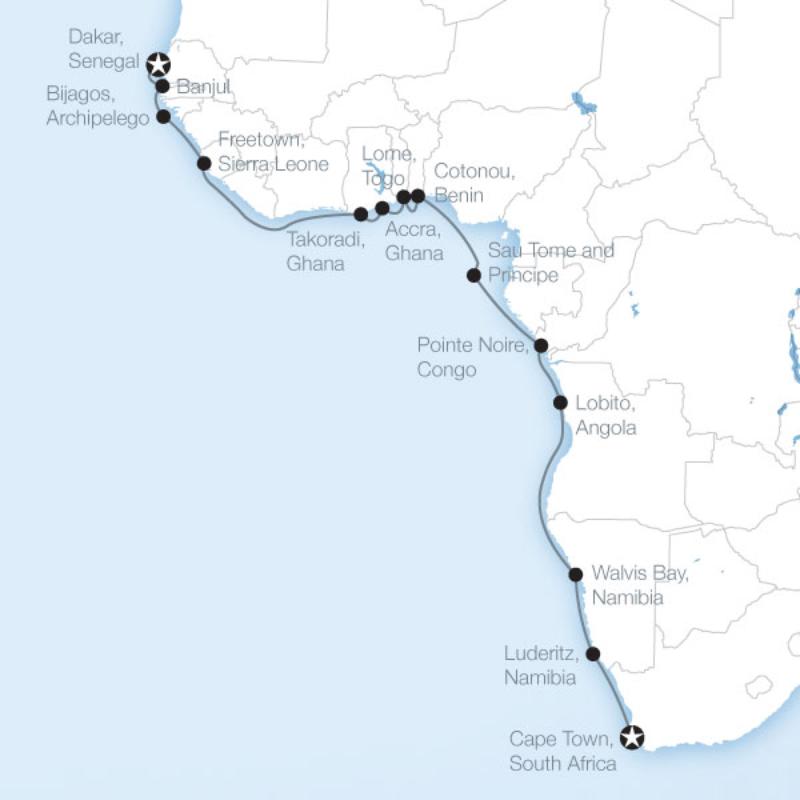
Our ship, the MS Expedition, is tracing the western coast of the continent of Africa from Cape Town to Dakar, Senegal, over 24 days. Already we’ve gazed from the dizzying heights of Table Mountain in Cape Town, trudged the abandoned structures of Kolmanskop on the edge of the Namib Desert and investigated the Portuguese colonial remnants of the once worn-torn nation of Angola. Ahead of us are the grisly Ghanaian slave ports of Elmina and Cape Coast where visitors report hearing the ghostly whispers of long departed slaves in the pitch black dungeons.

The coast of West Africa is one of the last remaining parts of the world unexplored by the planet’s inquisitive fleet of adventure vessels. While the larger ships of Cunard and Crystal are comfortable stopping by the safe Namibian ports of Luderitz and Walvis Bay, it’s only recently that adventure cruise operators have deemed Angola, Congo, Sao Tome and the Gulf nations sufficiently crisis-free to allow tourist ship visits.

Even so, all precautions are taken and from Point Noire in Congo until Accra in Ghana, we are joined by three very businesslike ex-Royal Marines who stand vigil while MS Expedition passes through the region where their presence is deemed necessary.

Who else goes there?

Hapag-Lloyd is sending MS Bremen in October for 23 days and while Saga Cruises, Silversea, Lindblad and Zegrahm list the West Coast of Africa as an itinerary, none have scheduled departures at time of writing. Freighter voyages are available too. 40 days return from Amsterdam to Lagos.


Bill Peach Journeys Classic Australian Aircruise


Around Australia by private jet. Sounds like a dream, but it's for real and Bill Peach Journeys have been doing it for 30 years. Jump aboard for the Classic Australian Air Cruise. [contact]

Travel Lines - 2012 flipbook


37 pages of editorial and pictorial offerings from the latest destinations and locations


Malaysia's Ghost Capital


Malaysia's grand vision of a planned administrative capital was intended to follow the great examples of Brasilia, Islamabad, Washington and Canberra.

Located 25 km south of Kuala Lumpur, the city is laid out with much use of green space and state-of-the-art urban planning.

All the important government departments are there as well as regal residences, but where is the population?

MPs and diplomats were supposed to relocate from KL en masse, but have so far refused to do so. Their empty palatial residences await their arrival.

Hotels like Pullman and Shangri-La remain almost empty. Great skyscrapers lunge for the heavens, but how much space is occupied?

The cracks are starting to show as many facades are finished but the contents remain void. The futuristic monorail system lies idle and unfinished.

Despite its design prowess, it has been described variously on the web as:

"Pyongyang without the parades."
"artificial city lacking life"
"Malaysia’s Frankenstein city"
"Mahathir’s Fatehpur Sikri"
Malaysia’s Frankenstein city
"a 1:1 scale model city" or more bluntly
"a planning failure"

A weekend cycle ride around the wide flat pavements and you feel like a location scout for the next post-apocalyptic drama.

Kruger National Park: Life and Death in the Dark


(original images)

“The lions have made a kill,” crackled the thick Afrikaans-accented voice over the 2-way radio, “we’re on them now.”

And with that, our Land Rover sped off down the bumpy track, long shadows from the setting sun creating crazy shapes in the long grass and low shrubs.

Minutes later, we’re on the scene already now in near darkness as the last embers of the setting sun fall below the distant tree line. Jacob shuts off the 4WD’s noisy diesel engine and we coast the last few metres, coming to rest close to the action. At first it’s just a jumble of dark apparitions jostling in the bush interspersed with the occasional ‘crunch’ as a rib or leg bone is crushed in the lioness’s powerful jaw.

The spotlight reveals three young lions feasting on the carcass of a freshly killed buffalo. In rotation, they come in for a few mouthfuls, tearing the flesh and sinews from the bones then ambling away for a rest before resuming the bloody buffet. This is life and death in wild Africa and we’re right there in the thick of it.

For perhaps a half hour we just sit silently watching as the meat disappears into the bloated bellies of the small pride. The carnivores, intent on the task at hand, pay us not the slightest heed, despite the flashing of torches and spotlights, tearing and gnawing at the bush banquet.

At almost 20,000 sq kms, Kruger National Park in the far north-eastern corner of South Africa is one of the largest game reserves on the continent. Most visitors come for the day, but a handful of ultra-exclusive lodges retain legacy privileges and have premises within the boundaries of the UNESCO-listed biosphere.

----------------

The story continues to describe facilities and services at the host accommodations and venues:

JOCK SAFARI LODGE
www.jocksafarilodge.com

TINGA LODGE
www.tinga.co.za

LION SANDS
http://www.lionsands.com/

The writer was a guest of South African Tourism and also attended the INDABA Tourism Trade expo in Durban.

The writer can supply both original and PR-sourced imagery.

Travel was sponsored by South African Tourism and the respective resorts/hotels.

Also available: Durban, Cape Town, Franschhoek Winelands

EMAIL for further details

Chiang Mai: Pillars of Tranquility

Story starter only


The former royal city of Chiang Mai in Thailand’s mountainous north, rises above the noise from the rowdy south. Roderick Eime escapes the rabble.

“Everything in Siam has its own time”

So said the bold Anna Leonowens to King Mongkut in that famous piece of semi-fiction, “Anna and the King”

And if that time was now, the former Kingdom of Siam has indeed come into its own.

While the southern territories abound in hedonistic pleasures, attracting record tourist numbers, the north retains the charm and beauty that so enthralled the 19th century royal governess. With her precocious son, Louis, the two lived in the King of Siam’s court for six years from 1862. Anna left, never to return, while Louis returned 15 years later to begin an enterprise in the burgeoning teak trade.

He returned to the former seat of the royal family, Chiang Mai, and built a magnificent manor in the traditional Thai style. That residence has now been restored and forms the centrepiece of the superb new boutique resort, 137 Pillars House.

So called because of the number of teak pillars on which the house was built, the immaculately renovated structure now hosts the restaurant, bar and lounge of the property and transports guests back to a time of colonial opulence.

========

Further points to consider any story:
  • Chiang Mai supports a busy adventure/adrenalin tourism sector with animal parks, off-road tours, cultural villages and bungee/ziplines.
  • Chiang Mai is applying to UNESCO for ‘Creative City’ status along with cities such as Melbourne, Berlin and Buenos Aires.
  • Chiang Mai is the only tourist destination in Thailand to have made it into the 2012 TripAdvisor list of "25 Best Destinations in the World".
  • 137 Pillars House has been included in the 2013 HOT LIST of the Best New Hotels in the World by Conde Nast Publications.
  • 137 Pillars House featured in Travelite Spring 2013 Destination Hot List
  • 137 Pillars House is a member of the SLH group and is managed by SilverNeedle Hospitality.

I think I'm going Macanese


In July I returned to Macau to see for myself the development that has occurred since my previous visit in May 2006. Macau is developing at a staggering pace, to say the least.
  • 2013 Images - includes Hong Kong and PR-sourced images
  • 2006 Images - includes Hong Kong and PR-sourced images
Earlier stories:
Macau in a Hurry: 12 Hours in Macau

After almost 400 years of blissful colonial slumber, the new Special Administrative Region of Macau is already rivalling the world’s major leisure capitals. Roderick Eime ponders the possibilities for a whirlwind tour.

Half a day in Macau is like twenty dollars in a toy shop - so much to choose from, but some hard choices await.

Historic Snapshot:

Even though Macau is best known for its rich Portuguese heritage and eclectic mix of European and Asian cultures, the town’s maritime and trading history dates back to the 5th century and earlier when coastal traders and fishermen used Hoi Keang for resupply. Many historians also believe the port was used by the enormous fleets of the Ming dynasty during 1421-23 as part of their theorised discovery of the world.

In 1513, the Portuguese merchant and explorer, Jorge Alvares, landed and almost immediately began a trading relationship with the local Cantonese (Guangzhou). The Europeans established various temporary outposts before reaching an arrangement with the mandarins in 1557 to settle the tiny peninsula at the mouth of the Pearl River estuary, now modern Macau.

Through intermittent chapters of stagnation and turmoil, most significantly Macau has returned to Chinese rule as a Special Administrative Region (SAR) of the People's Republic in 1999, ending 329 years of colonial Portuguese stewardship.

The Hard Choices:

Before you arrive, grab your copy of Lonely Planet and do some homework. You’ll quickly discover there are several paths available to you. For example;

Chinese culture and cuisine.
Portuguese architecture and history.
Modern diversions: gaming, adrenalin and nightclubbing
Peruse the list below and begin your shopping list of activities

Macau Tower

Designed principally by Gordon Moller of CCMBECA, New Zealand, Macau Tower is one of the world’s greatest city towers. At 338m, it is the 10th tallest in the world. Visitors can enjoy a scenic meal at the 360o Café and those with a yen for thrills can take the ultimate plunge with a 233m drop on the AJ Hackett Skyjump; one can climb the mast or walk the elevated platform. Not for the faint-hearted.

Guia Fortress Lighthouse and Chapel

One of several fortresses and barracks throughout Macau, the Guia was built between 1637-38, and occupies the top of Guia Hill, the highest point in Macau. Originally designed to defend the city from sea attacks, its position overlooking the entire city makes it one of the best observation posts.

Fisherman’s Wharf

Located at Macau’s Outer Harbour, this themed tourist district contains a dense assortment of restaurants, bars, nightclubs and retail establishments built to reflect Macau’s original colonial style as well as drawing on other maritime cultures and locations like Cape Town, Amsterdam and New Orleans.

Museums

Macau is a museum-goer's delight. The city has numerous world-class museums dedicated to the its rich natural and cultural history.Tip: For MOP$25 for adults and MOP$12 for children and seniors, visitors can buy a museum pass that grants entry to the Grand Prix Museum, Wine Museum, Maritime Museum, Lin Zexu Museum, Museum of Art and Museum of Macau.

St Paul’s Crypt and Museum of Sacred Art

Built at the bottom end of the inner area of the St. Paul's ruins is this superb museum with a rich display of religious art and artefacts. It was built in the location of the chancellery of the ancient church which was destroyed by fire in 1835.

Maritime Museum

Adjacent to the A-Ma Shrine, this compact, but beautifully detailed museum celebrates Macau’s complex maritime history. The three floors are arranged like decks and include excellent displays of ancient explorers like Vasco da Gama and the great Ming Dynasty Admiral Cheng Ho, plus fascinating models and dioramas.

Grand Prix Museum

Assuage your motor racing urge with a visit to this museum which includes actual race cars, bikes and replicas along with memorabilia and souvenirs. Jump into the simulator for a race around the famous circuit.

The Museum of Macau

Located at the Monte Fort and facing St.Paul's ruins, the museum also occupies the ancient fortress built by the Jesuits at the beginning of the 17th Century. This museum is a wonderful introduction to the development of life and civilisation in and around Macau over the centuries.

Macau Grand Prix: Asia’s Most Significant Motor Sport Event

First held in 1955, soon after the restoration of Formula One in Europe after its wartime hiatus, the Macau Grand Prix has evolved as arguably the most historic and significant Asian motor sport event.

If you arrive in Macau during Grand Prix, there will be little else going on as the entire city is consumed with this high octane carnival.

The 54th Macau Grand Prix will be held from November 15th to 18th 2007.

Macau’s unique European cultural fusion has spawned a range of colourful cultural events including arts, music and fireworks festivals, a dragon boat regatta, golf tournament and a marathon foot race. Depending on your arrival date, you could find yourself consumed with any of these events.

UNESCO World Heritage Self-Guided Tour

The United Nations recognised the very special significance of the architectural heritage of Macau by listing the centre of the old city as a World Heritage site of cultural significance.

The historic and cultural “branding” of old colonial Macau is perhaps best portrayed by the preserved façade of the Cathedral of Saint Paul. Built during the last decade of the 16th Century by the Jesuits, the building was destroyed by fire in 1835 during a typhoon.

The proximity of the landmarks makes this expansive World Heritage site an engaging and vigorous self-guided walking tour that could easily occupy several days.

Culture and History Getting You Down? – Roll the Dice!

Apart from the cultural and historic significance of the port city, Macau is known worldwide for its gambling history which began with the Chinese workers and merchants who populated the growing city soon after the arrival of the Portuguese. Macau is now the highest-volume gambling centre in the world

Since 2002, the gaming scene has been deregulated and new players are coming to town including the Sands Macau, the largest casino in the world as measured by the number of gaming tables, in 2004 and Wynn Macau in 2006. Other casinos and hotels opening before 2010 include: The Venetian Macao, Four Seasons, MGM Grand Macau, Ponte 16, Far East Consortium Complex, Grand Hyatt, Galaxy Cotai Megaresort, City of Dreams, Oceanus and Mandarin Oriental.

Dining

As with any Asian society, food plays a major role in Macau, but its cuisine is flavoured by hundreds of years of multicultural influences Among the more popular Macanese dishes are African chicken grilled in peppers, Tacho (a robust stew of Chinese vegetables and different meats), Galinha Portuguesa (chicken cooked in an oven with potatoes, onions, egg and saffron), Linguado Macau (Macau sole fried and served with green salad) and Porco Balichao (Balichao pork). A popular dessert is the Jagra de ovos (sweet egg tart). The best sampling of these local specialties can be found at the unique Macanese style eateries dotting the island. Operated by Portuguese-speaking European descendants, these quaint little cafes and restaurants capture the essence of Macau perfectly – check them out along Rue Almirante Sergio and along the Praia Grande. Other cuisines can also be enjoyed widely in Macau, include excellent Cantonese fare, a variety of Western food, Japanese cuisine and ethnic Portuguese dishes.

April 2013: Cape Town to Dakar aboard MS Expedition


West Africa aboard MS Expedition


For all of April 2013, Rod will travel the wild west coast of Africa, sailing aboard the 140-pax MS Expedition, visiting ports and countries seldom explored by cruise ships. Operated by G Adventures (formerly GAP), this 27-day odyssey is bound to be full of surprises.

You can see the whole itinerary here, but just quickly, we'll visit these countries:
    click to enlarge
  • Angola
  • Benin
  • Congo - Brazzaville
  • The Gambia
  • Ghana
  • Namibia
  • Sao Tome and Principe
  • Senegal
  • Sierra Leone
  • South Africa
  • Togo
If you'd like to see something from this trip, please let him know now. No obligation.

EMAIL

Look who's talking

Welcome to my new temporary website.

Welcome to Travography, the website for Australian travel journalist and broadcaster, Roderick Eime. This is a new location for this website...